
What is Highest and Best Use in Real Estate?


If you've ever looked at a vacant parcel and wondered, what should I do with it? - you're already thinking about highest and best use. It's one of the most important concepts in real estate, and can be time-consuming to figure out manually.
Understanding a property’s highest and best use has traditionally required extensive research, detailed reports, and significant costs for attorneys, engineers, and appraisers- often before even determining whether a deal is worth pursuing. LandApp streamlines this process with its Value Index scores, which evaluate a property’s suitability across 13 different uses. The highest score highlights the property’s most optimal use, delivering in seconds what once took weeks to uncover.
What is Highest and Best Use in Real Estate, and Why is it Important?
Highest and best use refers to the most valuable and profitable way a property can be used based on its physical characteristics, zoning regulations, market demand, and financial potential. In real estate and land management, determining a property’s highest and best use helps landowners, property investors, and developers understand how to maximize the value and income potential of their land. This principle helps ensure that landowners receive fair and full compensation by recognizing the property’s maximum potential value. It is also a key factor in property appraisals, investment analysis, land planning, and determining fair market value.
HBU analysis drives nearly every major land decision: acquisition pricing, development feasibility, disposition strategy, and financing. Appraisers use it to anchor valuations. Investors use it to find hidden upside. Developers use it to avoid costly mis-zoning and wrong-use builds. Get it right, and you unlock a property's full potential. Get it wrong, and you build the wrong thing in the wrong place- or worse, sell too cheap.
For example, a flat, sun-drenched parcel in west Texas isn't just "empty land." It could be a solar farm generating long-term lease income. A hilltop ridge in Wyoming might be wind-worthy. A parcel near a highway interchange could be the next EV charging hub. The analysis determines which of those paths yields the highest return- that's the highest and best use.
How to Determine Highest and Best Use of a Property
Highest and best use is a core concept in real estate appraisal, and The Appraisal Institute plays a major role in defining and teaching how it is applied. The Appraisal Institute has developed a framework called “The Four Tests,” which outlines the key criteria appraisers use to evaluate a property’s highest and best use. A use must pass all four to qualify, and the one that scores highest across all four is the answer.
These four tests are:
Legally Permissable
Physically Permissable
Physically Possible
Maximally Productive
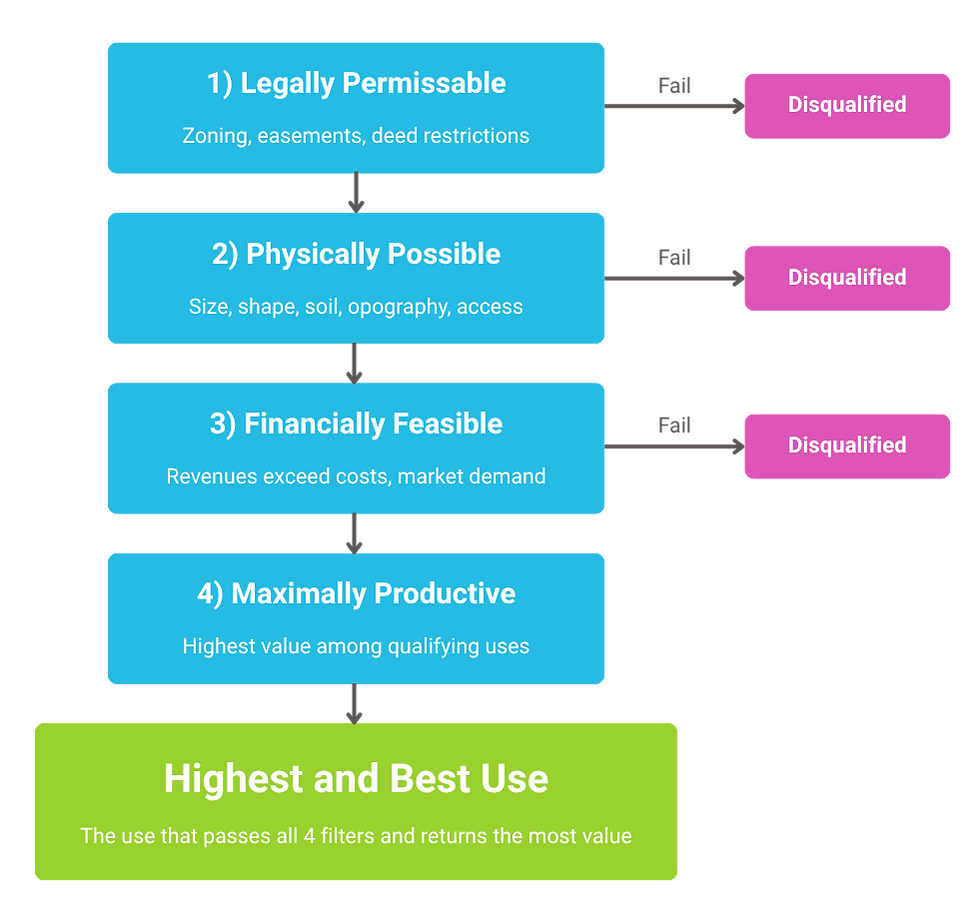
Filter 1: Legally Permissible
Before anything else, you need to know what the law allows. This means reviewing current zoning classifications, overlay districts, deed restrictions, easements, and any environmental designations that limit use. A parcel zoned agricultural can't simply be converted to an industrial data center- at least not without a rezoning process that adds time, cost, and uncertainty. Only uses that are permitted (or realistically permissible through entitlement) survive this filter.
Determining legal permissibility often requires more than a quick zoning lookup. Attorneys and land use experts are frequently needed to interpret deed restrictions, navigate overlay districts, assess variance or rezoning prospects, and identify environmental designations that aren't obvious from a county map.
Filter 2: Physically Possible
Zoning clears the legal path, but the land itself has to cooperate. This filter examines the parcel's size, shape, topography, soil bearing capacity, flood zone status, utility access, and road frontage. A parcel with steep grades and no utility connections may be legally zoned for development but physically unsuitable for it. Solar and wind projects add further physical variables, like irradiance levels, prevailing wind speeds, grid proximity. This is where data density starts to matter.
The physical possibility filter typically calls in engineers. Geotechnical engineers assess soil bearing capacity and subsurface conditions. Civil engineers evaluate grading, drainage, and utility extension feasibility. For energy projects, specialized consultants analyze grid interconnection, wind resource data, or solar irradiance. Each engagement takes time and carries cost- often before you know whether the deal will move forward.
Filter 3: Financially Feasible
A use that's legal and physically workable still has to make economic sense. This filter tests whether the revenues a use generates exceed the costs to develop and operate it, at a return threshold investors would accept. Market demand plays a role too. For example, an office development in an oversupplied submarket may pencil out in theory but fail in practice. Uses that don't meet a feasibility threshold are eliminated here.
Financial feasibility and maximum productivity are the domain of real estate analysts, appraisers, and market experts. They build pro forma reports, run comparable sales analyses, model lease rates for alternative uses, and stress-test returns against development costs. For complex or multi-use parcels, this phase alone can run weeks.
Filter 4: Maximally Productive
This is the decisive step. Among all uses that passed the first three filters, which one produces the highest property value? This is typically measured as the use that supports the greatest land residual value, which is what's left after development costs are subtracted from projected revenues. The winner is the highest and best use.
The Problem With Traditional HBU Analysis
Classic HBU analysis involves stacking layers of research: zoning laws, soil reports, topography data, solar irradiance tables, wind speed databases, grid infrastructure proximity, environmental restrictions, and market comps. A thorough analysis can take days or weeks, and still carry significant uncertainty. For investors evaluating dozens of parcels at once, that's a real constrain.
How LandApp's Value Indexes Help with HBU Analysis
In practice, running all four filters across multiple potential uses- like solar, wind, development, carbon credits, EV charging, data centers, mining- requires stacking a significant amount of research. That's exactly the problem LandApp's Value Index Scores are built to solve.
LandApp's Value Index solves this with a single, data-driven score for each potential use case rated 0 to 100 generated instantly for any US property. Each score reflects a property's real suitability for a specific use, pulling from the underlying data that traditionally takes weeks to compile manually:
Solar scores reflect irradiance levels, grid proximity, and land slope
Wind scores incorporate wind speed data, turbine feasibility, and transmission infrastructure
Carbon credits scores assess tree cover, land type, and sequestration potential
Mining scores analyze subsurface geology and mineral rights data
Data center scores weigh power availability, fiber access, and land characteristics
EV charging scores factor in traffic patterns, highway proximity, and electrical infrastructure
Building Suitability scores factor in topography, soil stability, access, and zoning
The highest Value Index Score indicates the property’s highest and best use.
Value Index Score Example
Say you're evaluating a 200-acre parcel in New Mexico. The Value Index comes back like this:
Solar: 97 ← highest and best use
Wind: 0
EV charging: 73
Data center: 48
Carbon credits: 10
Mining: 0

The answer is clear: this parcel’s highest and best use is for a solar lease. As a result, you now know where to focus your due diligence, what kind of buyer or tenant to target, and how to price the asset. That clarity used to take weeks to arrive at. With LandApp, it takes seconds.
Final Thoughts & Key Considerations for HBU Analysis
The cumulative weight of that professional involvement- legal, engineering, financial- is what makes traditional HBU analysis so time-intensive. LandApp's Value Index compresses the research layer dramatically, so you can identify the most promising use cases before committing to full professional due diligence. You still may need an attorney, an engineer, and an appraiser- but you'll know which direction to point them from day one.
Start with a free property report. LandApp's Value Index scores are included in every property report, giving you instant HBU clarity on any parcel. No spreadsheets, no manual research stacking, no guesswork. Simply find your parcel on LandApp's map to get started.


