
How Do Solar Farm Lease Rates Vary By Location?


Solar energy has transformed from a niche alternative into a mainstream infrastructure asset, and that transformation has created one of the most significant new income streams available to rural landowners in decades. Developers are actively seeking land across the country, but the lease rates they offer are far from uniform. A landowner in North Carolina might receive very different terms than one with a comparable parcel in Texas or Illinois.
Understanding why rates vary and what that means for your specific property can be the difference between leaving significant money on the table and negotiating a lease that delivers reliable income for 25 to 40 years.
How Much Do Companies Pay to Lease Land for Solar Farms?
Nationally, companies pay between $700 to $2,500 per acre per year to lease land for solar farms, though outliers exist in both directions. For a 100-acre parcel, that translates to $50,000 to $150,000 in annual lease income- passive, stable, and typically indexed to inflation. But those numbers only mean something in context. Location is the single most powerful variable in determining where on that spectrum your land lands and how much you'd get paid to lease your land for a solar farm.
How Do Solar Farm Lease Rates Vary By Location?
Solar lease rates are shaped by a combination of regional energy markets, state policy, grid infrastructure, and developer competition.
Here's how the major solar leasing regions (California, Texas, and Arizona) compare:
California: As a leader in aggressive renewable mandates, California often commands some of the highest lease rates in the country. Because land is scarce and environmental regulations are stringent, "shovel-ready" land is at a premium.
Texas: The ERCOT market is unique. Texas has vast amounts of flat land and a streamlined permitting process, making it the volume leader. Prices here vary wildly based on how close you are to the "population centers" where power is needed most.
Arizona: With some of the highest solar irradiance (sunlight intensity) levels in the world, Arizona is a prime target for utility-scale projects. Rates here are driven by the land's proximity to massive transmission corridors that feed power into the regional grid.
While large-scale states like Texas and Arizona offer volume, smaller markets with aggressive state incentives can offer high per-acre lease rates. For example, Maryland’s aggressive Renewable Portfolio Standard (RPS) and the Brighter Tomorrow Act have created a high-demand environment for solar development on smaller parcels. Because the state requires a massive amount of solar to be built in a relatively small geographic area, developers are willing to pay a massive premium to secure the right land.
This 40-acre property in Maryland listed for lease for solar energy on LandApp's marketplace received a staggering $6,500 per acre per year offer:
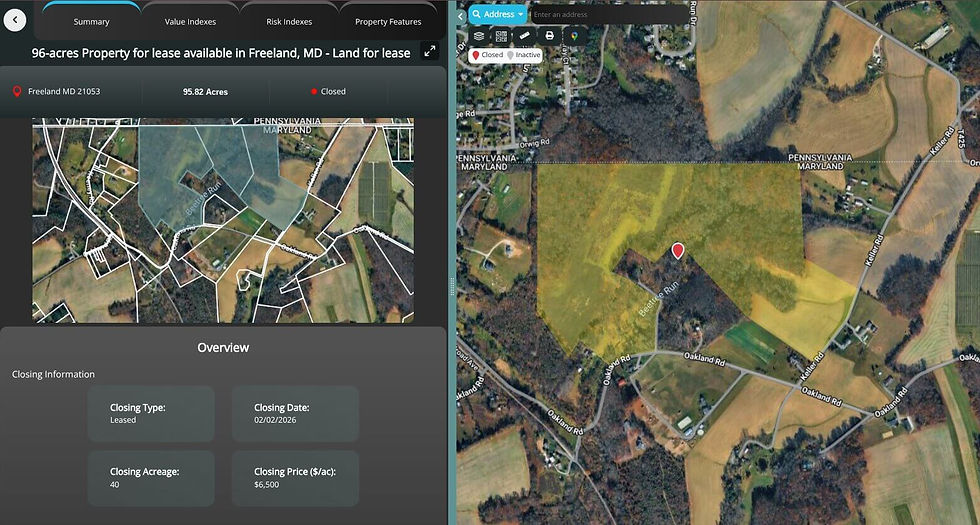
Landowners and realtors can list an unlimited number of properties for lease for solar energy completely free on LandApp's marketplace. There are no fees, commissions, or obligations to accept offers- just opportunity to receive top-dollar income from your land, like the landowner in Maryland above.
The Impact of Data Centers on Solar Farm Lease Rates
In 2026, the biggest driver of solar lease rates isn't just the sun- it’s data centers. With the explosion of AI, companies like Google, Amazon, and Microsoft are desperate for massive amounts of 24/7 power. To bypass grid congestion, developers are now co-locating data centers directly with solar farms. This "behind-the-meter" setup is opening up new opportunities for landowners. Because these projects often avoid some of the traditional grid-connection bottlenecks, developers are willing to pay premium prices to secure the land quickly.
Areas in Northern Virginia, Central Ohio, and the outskirts of Phoenix are seeing "Premium Pockets" where solar rates exceed national averages due to data center demand. So if you own or represent land in an area where data center demand is booming, you may be able to negotiate higher solar farm lease rates for your property.
Which Factors Drive Solar Farm Lease Rates Beyond Location?
Even within a single county, solar lease payments can vary substantially from one parcel to the next. Developers conduct detailed site analysis before making offers, weighing a set of land qualifications that either increase or decrease a property's value to them.
Here’s what makes land suitable for a solar lease and more attractive to developers:
Close Proximity to the Electrical Grid: Distance to transmission lines and electrical substations is arguably the most important site-specific factor. Land within a mile or two of a high-capacity substation is dramatically more valuable to developers than a comparable parcel that's five or ten miles away. Grid connection costs can run into the millions, and developers price that into their offers.
Solar Irradiance: The amount of usable solar energy (solar irradiance) a parcel receives annually directly affects how much power a solar farm can generate and therefore its revenue potential. Southern-facing, unshaded land with minimal tree cover performs best.
Zoning & Permitting Environment: Counties and municipalities with clear permitting pathways for utility-scale solar are far more attractive to developers than areas with restrictive zoning or community opposition. A favorable local regulatory environment can meaningfully increase what a developer is willing to pay and how quickly they'll move.
Parcel Size & Topography: Most utility-scale solar developers seek a minimum of 30 acres, with 100–500+ acres being ideal. Flat, regularly shaped parcels with minimal wetlands, floodplains, or significant elevation change are preferred.
State Renewable Energy Policy: States with binding Renewable Portfolio Standards (RPS) or aggressive clean energy goals create predictable, policy-driven demand for solar development. This competition among developers in compliant states drives rates higher. States with weaker policy mandates see less developer activity and lower baseline rates.
Why Landowners Often Don't Know What Their Land Is Worth
Most landowners who receive a solar lease offer have no independent benchmark to evaluate it against. Developers who conduct site analysis for a living know exactly what a parcel is worth to them. Landowners, absent their own research, typically do not. This information asymmetry almost always favors the developer.
A developer's first offer is rarely their best offer. And in some cases, landowners have accepted rates well below market simply because they had no way to know what neighboring parcels were leasing for or what multiple developers might have been willing to pay for the same site.
This is why understanding the factors above matter so much. It shifts the conversation from one where a landowner is reacting to an offer to one where they're evaluating it with full information.
Remember that all solar lease offers are negotiable, and it’s always recommended that you have a licensed attorney review a lease offer before you sign anything.
What Land Realtors Should Know About Solar Leasing
For real estate professionals working with rural or agricultural clients, solar leasing has become an increasingly important consideration. A long-term solar lease- particularly one with escalator clauses tied to inflation- represents a durable income stream that can materially affect how a property is valued, marketed, and transitioned between owners. Understanding the basics of how lease rates are determined allows agents and brokers to have more informed conversations with clients who may be sitting on land that solar developers are actively pursuing.
How Much Can I Earn to Lease My Land for a Solar Farm?
Solar lease rates are site-specific, and a national range can only tell you so much. The only way to know what your land is actually worth to solar developers is to look at the specifics of your parcel, like its location, its proximity to the grid, its size, and the policy environment around it.
LandApp's free property report does exactly that. In minutes, you can get a solar lease estimate tailored to your property. Simply find your parcel on our map to get your free solar lease estimate, then export a PDF report or click on the Solar Value Indexes link:

How to Receive Solar Lease Offers for Your Land
The best way to move from a $700/acre offer to a $3,000/acre offer is to have multiple developers bidding on your land. LandApp is the only online marketplace that allows you to list your land for solar leasing for free. By listing your property, you put your land in front of the nation's top developers who are actively seeking sites for utility-scale solar and data center co-location. There are no fees, commissions, or obligations to accept any offers:


