
Top Regions for Selling Carbon Credits in the U.S.

For landowners with timber, farmland, or forested acreage, carbon credits represent a growing income opportunity - one that doesn't require selling your land or dramatically changing how you use it. But not all land is equally valuable in the carbon market. Location plays a significant role. Here's what landowners need to know about which US regions are leading the way and how to find out what your specific property may be worth.
Key Takeaways
The top regions for selling carbon credits in the U.S. are the Pacific Northwest, the Southeast, and the Northeast.
Landowners can earn carbon credits through their soils and through their trees (reforestation, afforestation, harvest deferrals).
The main buyers of carbon credits in the U.S. include major tech companies, energy and utility corporations, and compliance market participants.
You can see how many carbon credits your property can generate with a free LandApp Property Report.
How are Carbon Credits Generated?
Before looking at geography, it’s important to understand how land generates carbon credits and the different types of carbon projects available.
There are four primary methods for generating carbon credits available to landowners:
Soil Carbon Sequestration: Agricultural soils can absorb and store carbon through practices like reduced tillage, cover cropping, and improved grazing management. Soil-based carbon credit programs exist, but the sequestration rates per acre tend to be modest compared to forested land.
Afforestation: This refers to planting trees on land that has not previously been forested. By establishing new forest cover, landowners can generate carbon credits over time as those trees grow and absorb CO₂. This approach requires a longer-term commitment and takes years to realize meaningful carbon volumes.
Reforestation: Reforestation involves replanting trees on land that was previously forested but has since been cleared, whether by logging, fire, or other causes. Like afforestation, this generates credits as new trees establish and sequester carbon, but it applies specifically to historically forested parcels.
Harvest Deferral This is where trees become the most valuable carbon asset a landowner can have. Harvest deferral carbon credits, sometimes called Improved Forest Management (IFM) credits, are generated when a landowner agrees to delay or reduce a planned timber harvest, allowing existing trees to continue sequestering carbon rather than being cut down.
Trees are the most effective carbon sequestration tool in the natural world. Mature forests store enormous quantities of carbon in their biomass, and that stored carbon is released when trees are harvested. Because of this, harvest deferral credits are among the highest-value credits available to landowners.
To qualify for harvest deferral carbon credits, your trees must genuinely be at risk of being cut down. Carbon buyers require proof of additionality, meaning the carbon storage only happens because of the financial incentive from the credit. Landowners that have a working forest that is actively managed or at risk of commercial logging are prime candidates.
Top Regions for Selling Carbon Credits in the U.S.
The top 3 regions for selling carbon credits in the U.S. are the Pacific Northwest, the Southeast, and the Northeast.
1) The Pacific Northwest
The Pacific Northwest (primarily Oregon and Washington) is the top U.S. region for selling carbon credits. This region has historically accounted for some of the largest enrolled acreage in US forest carbon programs. Driven by coastal rain and ideal growing conditions, the massive, long-lived tree species here - like Coast Douglas-fir and Hemlocks - store an incredible volume of carbon. Because these trees grow so large and live so long, a single acre in the PNW can generate more carbon credits than almost anywhere else in the country.
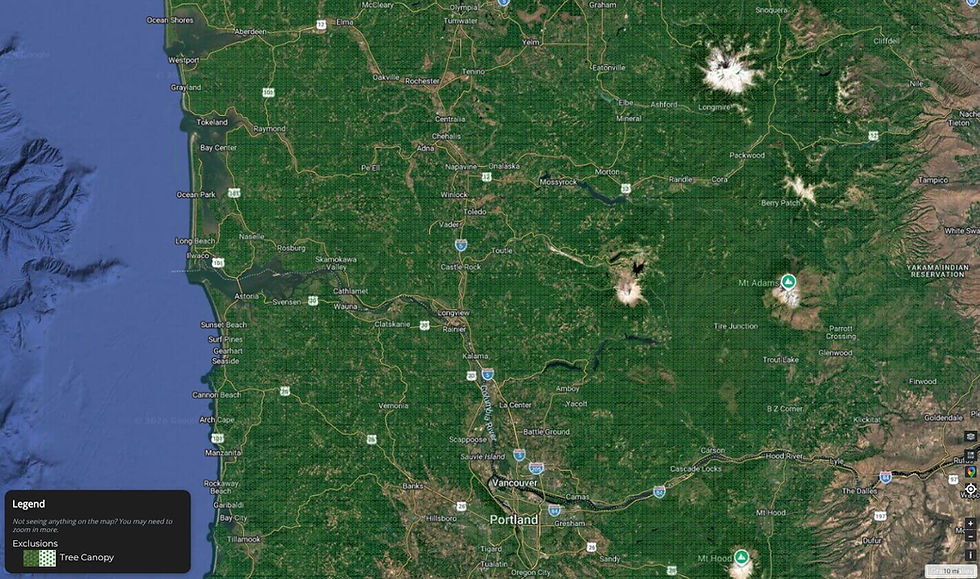
Washington State launched its own cap-and-invest program in 2023, and Oregon's compliance carbon program began in 2022, creating additional demand for locally sourced carbon offsets. This regulatory framework, combined with the natural productivity of Pacific Northwest forests and the presence of active timber markets, has long made the region attractive to carbon project developers.
For landowners in Oregon and Washington with mature conifer forests - particularly those with existing timber management plans - the conditions for harvest deferral eligibility are well established, and the per-credit value tends to reflect the higher carbon density of the trees.
2) The Southeast U.S.
While the Pacific Northwest wins on a per-acre basis, the U.S. South is the largest overall carbon sink in the nation due to its sheer scale. Spanning millions of acres of highly productive working pine and hardwood forests, the Southeast is the epicentered marketplace for timber. This means a vast majority of the land easily meets the requirement of being at risk of harvest, making the Southeast one of the most compelling for landowners exploring harvest deferral carbon credits.
The Southeast is home to over 1,600 timber mills and holds the greatest sawmill capacity of any region in the country. Private landowners here face significant and ongoing economic pressure to harvest their timber, which means their forests genuinely qualify as "at risk" under harvest deferral carbon market standards. States like Mississippi, Alabama, Arkansas, Georgia, and the Carolinas have large concentrations of pine plantations, including loblolly and slash pine, that are fast-growing and highly productive carbon sequesterers.
3) The Northeast (Appalachian and New England)
The Northeast U.S. is the third best region for selling carbon credits in the U.S. Stretching from the dense hardwood forests of Vermont down through the rich ridges of West Virginia and Pennsylvania, this region is packed with dense, heavy hardwood species. Hardwoods naturally store a massive amount of carbon dioxide equivalent per acre. Because roughly 85% of the forests in the Northeast are privately owned, it is one of the most active regions for family forest carbon programs.

Programs like the Family Forest Carbon Program, run by the American Forest Foundation and The Nature Conservancy, are actively enrolling landowners across states including Pennsylvania, West Virginia, New York, Vermont, Maryland, Massachusetts, Minnesota, Wisconsin, and Michigan. The Regional Greenhouse Gas Initiative (RGGI), which includes 11 northeastern states, also creates a structured compliance market that drives consistent demand for carbon offsets in the region.
Who Buys Carbon Credits in the U.S.?
The demand for carbon credits is soaring, driven entirely by the voluntary and compliance carbon markets. Compliance buyers are companies required by law to offset their emissions, while voluntary buyers are companies and organizations that purchase credits to meet self-imposed sustainability goals.
The main buyers of carbon credits in the U.S. include:
Major Tech Companies: Companies like Microsoft, Stripe, and Shopify are leading the charge when it comes to buying carbon credits, spending millions annually to meet aggressive net-zero or carbon-negative corporate sustainability goals.
Energy and Utility Corporations: Large energy providers and distributors purchase offsets to mitigate their infrastructure footprint.
Compliance Market Participants: Entities bound by strict state-level regulations, such as California’s cap-and-trade program, buy credits nationwide to legally offset their regulated emissions.
The demand side of the carbon credit market is broad, financially motivated, and increasingly competitive, which is good news for landowners with qualifying properties.
How to Determine Land’s Carbon Credit Value
The core formula for determining land’s carbon credit value is simple: carbon credit value is based on how many tons of CO₂ a parcel sequesters, multiplied by the price per ton in the carbon market. You can determine land's carbon credit value with a free LandApp Property Report.
LandApp's free Property Reports include:
A Carbon Credit Value Index Score rated on a scale of 0 to 100, so you can quickly gauge your land's potential relative to other properties
Tree-covered acreage data pulled from nationwide parcel maps
An estimated earning potential for selling tree-based carbon credits from your land
A separate estimate for soil carbon credits, based on your soil types, climate, and topography

Whether you own 50 acres of pine in Alabama, a Douglas fir stand in Oregon, or a mixed hardwood forest in Pennsylvania, your land may have untapped value in the carbon market.
Where to Sell Carbon Credits
If you're a landowner interested in monetizing your land's carbon potential, the process generally works as follows: you connect with a carbon credit developer or buyer, they assess your property, verify the carbon sequestration through a certified registry, and you receive payment in exchange for agreeing to specific land management terms over a set period.
LandApp offers a free starting point for landowners exploring this path. You can list your land for lease for carbon credits at no cost on LandApp's marketplace, giving your property visibility with companies actively looking for carbon credit opportunities. If a carbon developer is interested in your land, they will reach out and handle the verification process - LandApp connects landowners with these buyers but does not verify carbon credits itself.
Listing your land is free, with no obligation to accept any offers. Simply find your parcel on our map to get started:


