What is an Assessor’s Parcel Number (APN)?


An Assessor's Parcel Number (APN) is the unique identification code assigned to every individual plot of land by the local county assessor's office. APN’s are also called parcel numbers, parcel IDs, or tax IDs.
What is an Assessor’s Parcel Number (APN) and How Does it Work?
Unlike a street address (which can change, repeat across cities, or simply not exist for vacant land), an APN is a stable, permanent reference that ties every physical piece of earth to a specific entry in the county's tax and ownership records. Think of it as a Social Security number for real estate: no two parcels share the same one.
Every county in the United States maintains its own system for assigning APNs, so the exact format varies from place to place, but the underlying logic is consistent. For example, a California APN might look like 123-456-789, while a Texas ID (called an Abstract Number) might use a completely different structure. Most counties break the number into a series of segments, each representing a different geographic level of detail.
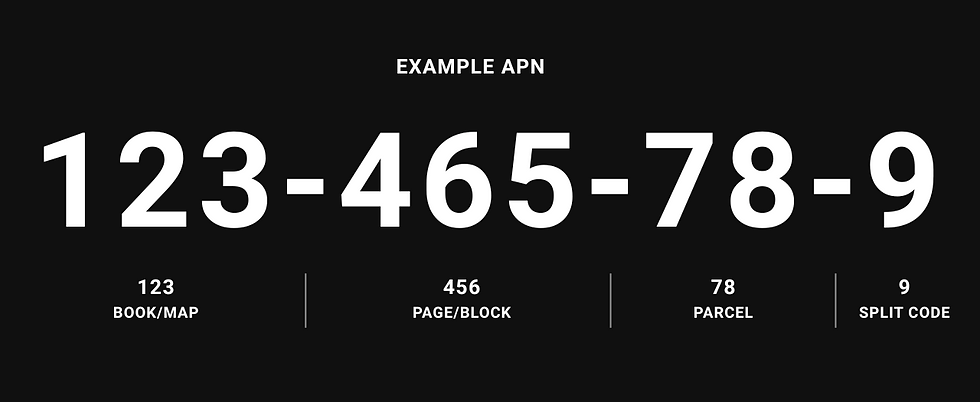
Typically, the first set of digits represents a map book or section- a large geographic area. The next segment narrows to a block or page, and the final digits identify the specific parcel within that block. Some counties add a fourth segment called a split code, which tracks parcels that have been subdivided from a larger lot.
When a parcel is split, the county doesn't necessarily change the core number. Instead, it appends or modifies a suffix so that both new parcels can be traced back to their common origin. This audit trail is one of the most valuable features of the APN system for researchers and title companies.
APNs are maintained by the county assessor. This is the office responsible for valuing all taxable property within the county each year. Because property assessor data underlies the entire property tax system, APNs are extraordinarily stable and reliable as a research tool.
What are Parcel Numbers Used For?
APNs are the backbone of land data systems. They connect a physical piece of land to all of its recorded information.
Parcel numbers (APNs) are used for:
Property Identification: APNs allow you to pinpoint exactly which parcel you’re looking at, down to the legal boundary. For vacant land and farmland with no street address, the APN is often the only reliable way to identify and describe a specific parcel in writing.
Property Tax Records: The APN is the primary key for every county tax record. With it, you can look up assessed value, annual tax bill, and payment history on almost any county assessor website.
Title and Deed Research: Title companies use APNs to pull chain-of-title records and verify land ownership. It's often faster and more precise than searching by owner name or address.
Zoning and Permit Lookups: Planning departments index zoning designations, permitted uses, and building permits by parcel number- essential for buyers evaluating land for development.
Real Estate Transactions: Every deed, mortgage, and lien is cross-referenced to an APN in county records. Attorneys, lenders, and agents all use it as the definitive parcel reference.
Boundary and Surveys Assessments: Surveyors reference APNs when researching neighboring parcels and easements. Knowing the APN of an adjacent lot speeds up due diligence substantially.
For real estate investors, APNs are especially powerful because they allow you to look up parcels that have no address at all, like raw land, landlocked parcels, and off-grid properties that would otherwise be nearly impossible to research. If you can find it on a map, you can find its APN, and from there, its full assessment history.
How to Find Your Parcel Number
Finding an APN is easier than most people think. You can find your parcel number on the county assessor website, your property tax bill, your deed or title, or by using online parcel mapping tools like LandApp.
County Assessor Website: Most county assessor websites have a free parcel search tool. Enter your property address and it will return the APN along with the current assessed value and ownership information.
Check Your Property Tax Bill: Your annual property tax statement- whether mailed or available via your county's online portal- will always list the APN prominently. It's typically labeled "Parcel Number," "APN," or "Tax ID."
Review Your Deed or Title: The recorded deed for your property, obtainable from the county recorder's office, includes the APN as part of the legal description. Your title insurance policy will list it as well.
LandApp’s Online Parcel Maps: This is where modern tools make things much easier. Open LandApp, navigate the map to your property, and tap or click the parcel. The APN appears instantly in the Parcel Data tab along with acreage, land use classification, and other key attributes- all free when you register for an account.

Once you have an APN, you're well-equipped to dig into the public record. From tax history to zoning classifications to ownership details, the parcel number is the master key to almost everything a county knows about a piece of land.
Common Questions about APNs
An APN might like a random string of numbers, but it’s actually one of the most important identifiers in real estate and land data. Whether you’re a landowner, investor, agent, or just curious about a piece of property, understanding APNs helps you quickly access accurate parcel-level information.
Is a Parcel Number the Same as an Address?
No, a parcel number is not the same as an address. An APN identifies the legal parcel, while an address is just the physical location.
Can 2 Properties Have the Same APN?
No, two properties can not have the same APN. Each parcel has a unique APN within a county.
Does an APN Every Change?
Yes, APNs can change if land is subdivided, merged, or reclassified. APN numbers are usually updated when a property changes (like after new construction or a transfer of ownership) but how often those updates happen depends on the county.
Can I Look Up an APN Number for Free?
You can look up an APN number for free on the local county assessor website or on online parcel data tools like LandApp. On LandApp, simply find a parcel on LandApp’s map here or on our free mobile app, then click on it and navigate to the Parcel Data tab.
To view APNs, ownership details, and sales history data for unlimited parcels nationwide, subscribe to LandApp Pro for $6/month.